

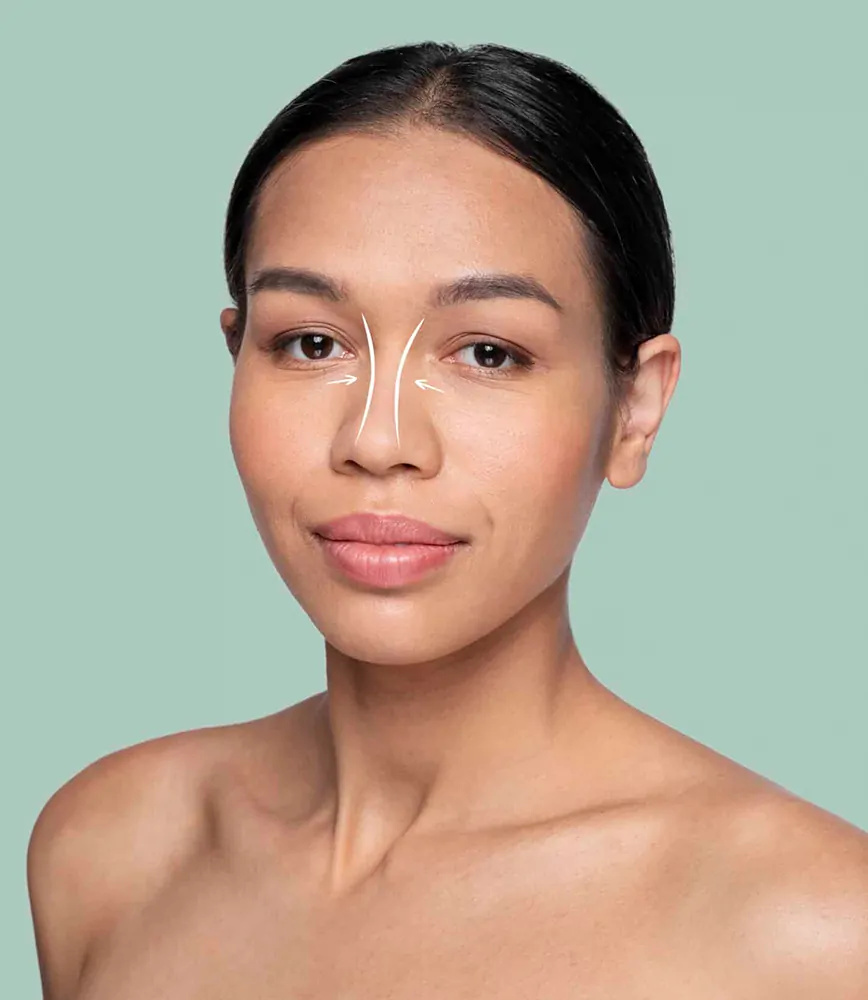
Enhance Your Unique Features with Ethnic Rhinoplasty
Ethnic rhinoplasty, which takes into account different ethnic characteristics, offers the opportunity to perform more natural and personalized rhinoplasty. It stands out as a personalized technique to eliminate congenital or acquired nasal deformities.
Ethnic rhinoplasty; It aims to provide a more harmonious and balanced nasal form by addressing the different anthropometric and anatomical features of the person. Rather than one type fits all with ethnic rhinoplasty surgeons take into consideration the patient’s facial anatomy and ethnic characteristics. The aesthetic procedure is performed with high precision, so it does not take away from the natural appearance of the person.
Ethnic rhinoplasty, which plays an important role in keeping cultural diversity alive, can be applied using different open and closed techniques. In addition, cartilage grafting is also performed when necessary to be suitable for deep radix and low nasal projection. In this way, while increasing the volume of the nose in harmony with the facial structure of the person, it also allows height and length adjustment.
What is ethnic rhinoplasty? How does it work, how long does the procedure take, what are it’s advantages, and which patients are suitable for ethnic rhinoplasty?
What is Ethnic Rhinoplasty?
While each ethnicity has its own characteristics, these characteristics are extremely valuable in terms of cultural diversity. Therefore, care should be taken to ensure that aesthetic interventions are performed by preserving this cultural diversity. Ethnic rhinoplasty is a type of rhinoplasty that is performed by remaining faithful to the traces of people’s ethnic backgrounds.
With ethnic rhinoplasty, which is performed to provide an aesthetic appearance by preserving the unique facial features of people, structural disorders in the nose are improved. Excessive nasal tip lift, low disproportionate nasal tip, wide nostrils, incompatibility of chin and forehead structure, and flat, small, or large nose problems are solved.
Ethnic rhinoplasty, which is applied using different surgical methods, aims to meet both aesthetic and functional expectations of patients. With special procedures performed in ethnic rhinoplasty, both the anatomical features specific to their origins are preserved and the nasal disorders that disturb the patient are eliminated.
The main difference with traditional rhinoplasty is traditional rhinoplasty is generally focused on nose reduction. In this context, it includes reductions in the nasal bone and cartilage. However, in ethnic rhinoplasty, nasal augmentation, and cartilage addition procedures are usually performed to create a nasal structure suitable for the ethnic origin of the person.
In ethnic rhinoplasty, many factors are considered in order to achieve successful results for the purpose. Skin type, color, thickness, face shape, and chin structure are among these factors. Since it is performed by considering all these factors, it does not adopt a single type of surgery approach suitable for everyone.

How Does Ethnic Rhinoplasty Work?
The duration of surgery in ethnic rhinoplasty may vary according to the method to be applied, the anatomy of the person and the specialist. For example, if the surgeon needs to harvest rib cartilage to increase tip projection that will make surgery longer.
Another factor affecting the duration of ethnic rhinoplasty (natural rhinoplasty) is whether nasal dorsum augmentation is needed. Despite available nonbiological materials to augment nasal dorsum the safest and long-lasting choice is patient’s own rib cartilage.Harvesting rib cartilage and reshaping it will make surgery longer but in this method success rate is very high.
Another determining factor in terms of duration is the ethnicity of the patient. For example, successful results can be obtained with open ethnic rhinoplasty in a Middle Eastern style nose structure. On the other hand, for those who need small interventions such as only tipplasty, closed surgery is usually sufficient. Therefore, the duration is longer or shorter depending on the patient rather than ethnicity.
Although the nasal structures of individuals with African American ethnicity look similar to each other, there are structural differences. These differences arising from bone, cartilage, and skin structure are decisive in the duration. For example, for some individuals, alar base surgery may be needed to achieve a narrower tip.
In ethnic rhinoplasty, although the duration of surgery varies according to the factors mentioned above, it is possible to say that it takes between 3-4 hours on average. This time may be longer if a very complex rhinoplasty procedure is to be performed. Therefore, in order to give a clear procedure time, the patient’s condition, needs and techniques should be discussed. Afterwards, a detailed planning is essential.
What is the Advantage of Ethnic Rhinoplasty?
Ethnic rhinoplasty, which allows patients to achieve the desired nose structure while preserving their ethnic characteristics, offers many advantages thanks to the advanced techniques it uses. The prominence of this aesthetic application recently is due to the advantages it offers to these patients.
The advantages of ethnic rhinoplasty are as follows:
- The results of the application made by addressing the ethnic characteristics of the person are extremely natural.
- While preserving the facial features that make the person unique, it allows to shape the desired nose structure.
- It is a professional approach as it is applied by experienced and trained specialists.
- It is a personalized aesthetic application with a special planning. Therefore, the results obtained create satisfaction.
- Correction of the nasal structure disorder that disturbs the person contributes to increased self-confidence. It also has positive effects on social life.
- It eliminates functional nasal disorders as well as aesthetic. Thus, it also contributes to the general health of the person.
- With the use of advanced technology and techniques, the risk of complications and side effects is low.
- Since it is applied with precision and advanced technologies, the recovery period is generally shorter. It offers the opportunity to return to daily life in a short time.
Ethnic rhinoplasty (natural rhinoplasty) applied with a personalized treatment plan usually gives satisfactory results. However, for the advantages and successful results it offers, it is essential to get help from a specialist in this aesthetic application. Otherwise, it is difficult to achieve a nasal structure that preserves the ethnic characteristics of the person and satisfies the person. In short, the procedure in this case cannot go beyond traditional rhinoplasty.
Am I Suitable for Ethnic Rhinoplasty?
The lower age limit of ethnic rhinoplasty, which preserves the special features of the origin of the person while removing structural defects in the nose, is those who are over 17 years old. Since the nose has not completed its development, it is not suitable for children and older individuals. Ethnic rhinoplasty is not recommended as the health conditions of some people will increase the risk of complications.
The features that suitable candidates for ethnic rhinoplasty should have are as follows:
- Those who are over 17 years old and dissatisfied with their nasal structure.
- Those who do not have health conditions that prevent rhinoplasty such as cancer, heart, blood disorder, and diabetes.
- Those with an overly upturned nose structure.
- Those with asymmetrical, disproportionate, and sagging nose structure.
- Those who are not satisfied with the appearance of the nose in length and width.
- Those with a nose structure incompatible with the forehead and chin.
- Those with an uncomfortably flat nose structure.
- Those who have a very small and nose experience discomfort due to this situation.
- Those who complain about the appearance of the nose and have the budget required for ethnic rhinoplasty.
- Those who have self-confidence problems due to structural defects in their nose.
In the first meeting with the specialist before the ethnic rhinoplasty (natural rhinoplasty) procedure, it is examined whether all these criteria are met. In addition, pregnancy, breastfeeding, and those with mental illness at a level to make their own decisions are not suitable for aesthetic surgery.
What is the Recovery Process After Ethnic Rhinoplasty?
The healing process is critical to get successful results in every aesthetic application. After ethnic rhinoplasty, the patient stays at the hospital for 1 night and the next day after the check-up examination the patient will be discharged. However, there are some topics that the patient should pay attention to during the healing process. By addressing these concerns, pain, soreness, nausea, and vomiting—common after the operation—are minimized. This also helps speed up the healing process.
Pain complaints in the first days after rhinoplasty are generally low. Medications prescribed by the specialist are mostly useful in managing complaints. In addition, it is normal to have slight bloody leakage from the nose in the first days. However, if the bleeding intensifies and lasts longer, it may be necessary to consult a specialist.
Swelling, edema and bruising around the nose usually heal at the end of the first week after the procedure. However, it is necessary to avoid picking and pulling the nose for a month. It may take up to 6-12 months for the edema to be completely removed. This period may be longer or shorter depending on the biological reactions of the person. It should be known that the duration is longer especially for those with thick nasal skin than those with thin skin.
During the healing process, the success of the procedure is evaluated with intermittent controls made by the specialist. In addition, the nose regains its new appearance approximately a few months after the procedure. If the desired results are not obtained after ethnic rhinoplasty, which generally has high success rates, corrections may need to be made with revision rhinoplasty. However, in the hand of an experienced specialist usually revision is
not needed.
Before – After Ethnic Rhinoplasty
Ethnic rhinoplasty generally has high success rates when compared before and after. It gives results that are natural, balanced with the facial structure of the person and do not disrupt the unique appearance.
As a result, ethnic rhinoplasty is a rhinoplasty procedure performed by addressing the ethnic characteristics of a person. This aesthetic operation, which preserves cultural diversity, allows the person to achieve the desired nose structure by preserving the characteristics specific to their origin. While it can be performed open or closed, it uses different techniques such as repositioning the nostrils, cartilage grafting and implant placement. In this way, it is a procedure that balances the facial features of the person and makes it look more aesthetic without breaking away from its essence.